Earth Anchors vs Ground Anchors: Which Solution Is Right for Your Project?
When planning a construction, infrastructure, mobile home, modular building, or retaining wall project, choosing the right anchoring solution is essential for long-term stability and safety. Two terms that are often used interchangeably are Earth Anchors and Ground Anchors. While they are closely related, there are important differences that can affect the performance and success of your project.
At B & R Stamping, we manufacture high-quality Earth Anchor Systems, Ground Anchoring Systems, Load Lock Anchors, Arrowhead Anchors, Frame Ties, and Structural Support Products for customers across Canada. Understanding the differences between these anchoring systems can help contractors, engineers, builders, and property owners select the best solution for their specific application.
What Are Ground Anchors?
Ground Anchors are a broad category of anchoring systems designed to transfer structural loads into the ground. These systems are used to provide resistance against tension, uplift, and lateral movement. Ground anchors are commonly used in construction, infrastructure, retaining walls, embankments, slope stabilization, and industrial projects where additional structural support is required.
Ground Anchors can be installed in soil, rock, concrete, or mixed ground conditions. Depending on the project, they may use mechanical locking systems, expansion mechanisms, or specialized anchoring methods to achieve the required holding strength.
Because Ground Anchors cover a wide range of products and installation methods, they are often considered the general category of below-grade anchoring solutions.
What Are Earth Anchors?
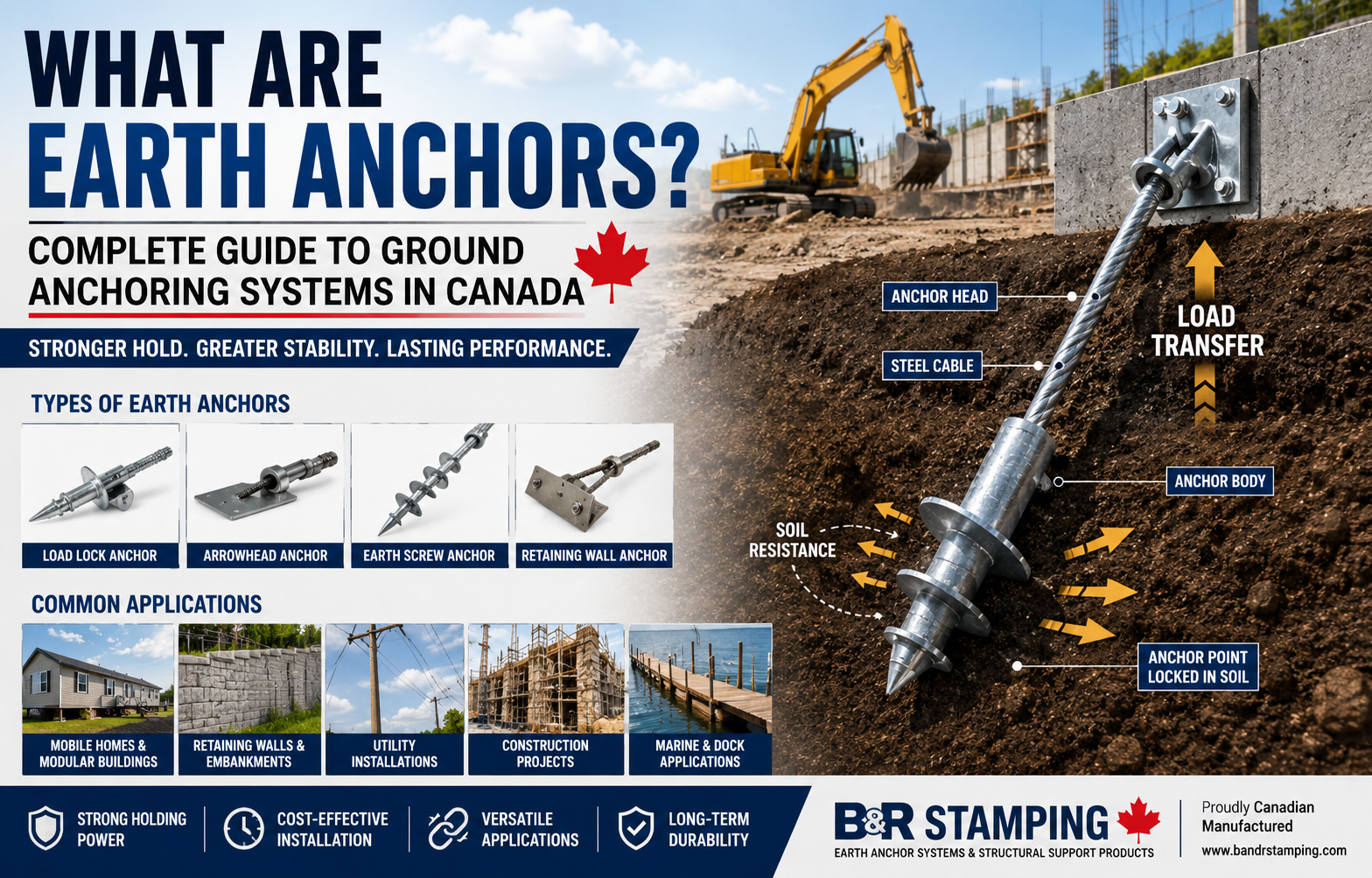
Earth Anchors are a specific type of Ground Anchor designed primarily for installation in soil conditions. They secure structures by creating resistance within the surrounding earth, helping prevent movement caused by wind loads, soil pressure, vibration, or environmental forces.
Earth Anchors are widely used throughout Canada for securing:
- Mobile homes
- Manufactured housing
- Modular buildings
- Portable structures
- Utility installations
- Temporary structures
- Storage buildings
- Retaining walls
- Ground stabilization projects
Unlike some larger engineered ground anchors that require extensive drilling and grouting, Earth Anchors are often designed for faster installation while still providing exceptional holding power.
Earth Anchors vs Ground Anchors: Key Differences
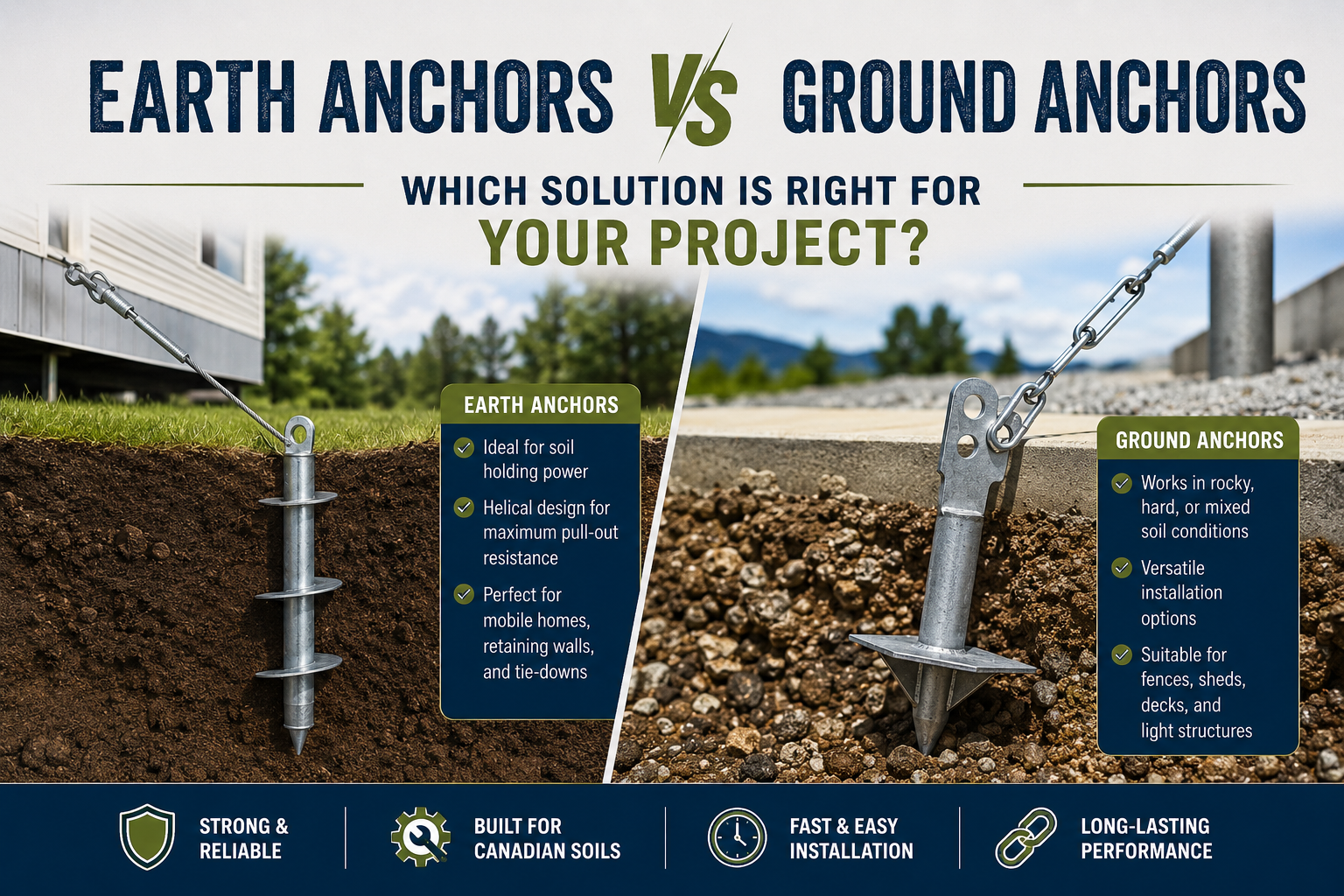
The primary difference is that Ground Anchors represent a broad category of anchoring systems, while Earth Anchors are specifically designed for use in soil.
Ground Anchors may be installed in rock, concrete, embankments, slopes, or soil conditions depending on project requirements. Earth Anchors are generally intended for soil-based applications where dependable holding strength and efficient installation are important.
Another difference involves project size and complexity. Ground Anchors are often used in large infrastructure and engineering projects, while Earth Anchors are frequently used for mobile homes, portable structures, utility installations, and commercial applications.
Although the terminology is different, both systems serve the same purpose—providing stability, safety, and resistance against movement.
Advantages of Earth Anchors
Earth Anchors offer several benefits for residential, commercial, and industrial projects.
One major advantage is their ease of installation. Many Earth Anchor Systems can be installed quickly using standard tools and equipment, reducing labor costs and project timelines.
Earth Anchors are also highly versatile and can be used in a variety of applications, including modular buildings, mobile homes, sheds, utility structures, and temporary installations.
Another benefit is their strong holding power. When properly installed, modern Earth Anchors can provide excellent resistance to uplift and movement, helping structures remain secure even in challenging weather conditions.
Advantages of Ground Anchors
Ground Anchors are often selected for projects requiring higher load capacities and specialized engineering solutions.
They are commonly used for retaining walls, embankment stabilization, infrastructure construction, excavation support systems, and slope reinforcement projects.
Ground Anchors can be designed to accommodate complex soil conditions and large structural loads, making them suitable for heavy-duty construction and engineering applications.
For projects involving significant structural demands, Ground Anchors often provide the long-term performance and reliability required by engineers and contractors.
Load Lock Anchors and Arrowhead Anchors
B & R Stamping manufactures two popular Earth Anchor solutions used throughout Canada: Load Lock Anchors and Arrowhead Anchors.
Load Lock Anchors are engineered to provide exceptional holding power and structural stability. These anchors work by rotating and locking into position beneath the soil surface after installation. This unique design allows them to engage undisturbed soil and achieve superior anchoring performance.
Load Lock Anchors are commonly used for:
- Mobile homes
- Portable buildings
- Utility installations
- Construction projects
- Ground stabilization applications
Arrowhead Anchors
Arrowhead Anchors are manufactured using heavy-duty steel and are designed to provide dependable ground anchoring in a wide range of soil conditions.
These anchors are frequently used for:
- Mobile home tie-downs
- Shed anchoring
- Portable structures
- Utility projects
- Temporary installations
Their durable construction and galvanized cable assemblies make them a reliable choice for long-term outdoor use.
How to Choose the Right Anchoring Solution
Selecting the right anchoring system depends on several factors.
First, evaluate the soil conditions. Different soil classifications affect anchor performance and installation depth requirements.
Second, determine the load requirements of the structure. Larger structures or projects exposed to higher wind loads may require stronger anchoring systems.
Third, consider environmental conditions such as frost, moisture levels, wind exposure, and ground movement.
Finally, assess whether the project requires a temporary or permanent anchoring solution. Understanding these factors will help ensure that the selected anchor system provides maximum performance and long-term stability.
Conclusion
Choosing between Earth Anchors and Ground Anchors depends on your project requirements, soil conditions, and structural demands. Ground Anchors represent a broad category of anchoring systems used in many construction and engineering applications, while Earth Anchors are specifically designed for soil-based stabilization and structural support.
For mobile homes, modular buildings, portable structures, and general ground stabilization projects, Earth Anchors such as Load Lock Anchors and Arrowhead Anchors often provide an effective and cost-efficient solution. For retaining walls, embankments, and large infrastructure projects, Ground Anchors may be the preferred choice.
At B & R Stamping, we manufacture high-quality Earth Anchor Systems, Ground Anchoring Systems, Load Lock Anchors, Arrowhead Anchors, Frame Ties, and Structural Support Products designed to deliver dependable performance throughout Canada. Contact our team to learn more about selecting the right anchoring solution for your next project.
Recent Posts
- Custom Metal Fabrication in Oakville: Industry Applications
- How to Choose a Reliable Welding Company in Canada
- Best Practices for Anchor Placement and Installation
- Arrowhead Earth Anchors: Features, Benefits, and Applications
- Why Contractors Choose Load Lock Anchoring Systems
- How to Choose the Best Earth Anchor System for Construction Projects in Canada
- Understanding the Anchoring Principle: How Ground Anchors Hold Loads
- What Are Arrowhead Anchors and How Are They Used?
- What Are Leveling Jacks and Why Are They Important?
Frequently Asked Questions?
Ground Anchors are a broad category of anchoring systems used to transfer loads into soil, rock, or concrete. Earth Anchors are a specific type of Ground Anchor designed primarily for soil-based applications such as mobile homes, portable buildings, and ground stabilization projects.
Neither is universally better. The right solution depends on the project. Earth Anchors are ideal for soil conditions and mobile structures, while Ground Anchors are often used for retaining walls, infrastructure projects, and high-load engineering applications.
Earth Anchors are commonly used for mobile homes, modular buildings, sheds, portable structures, utility installations, retaining walls, scaffolding, and ground stabilization systems.
Ground Anchors are used for retaining walls, embankment stabilization, slope reinforcement, bridge construction, excavation support, infrastructure projects, and structural tie-back systems.
Earth Anchors are installed below the ground surface and activated by tension. Once locked into position, they engage undisturbed soil and create resistance against uplift, movement, and structural loads.
Earth Anchors can be installed in many soil conditions, including clay, sand, gravel, and mixed soils. The holding capacity depends on soil density, moisture content, anchor design, and installation depth.
Load Lock Anchors are high-performance Earth Anchors designed to rotate and lock beneath the soil surface when tension is applied. They provide excellent holding power and long-term structural stability.
Arrowhead Anchors are heavy-duty steel Earth Anchors used to secure mobile homes, sheds, portable buildings, utility structures, and temporary installations requiring reliable ground anchoring.
B & R Stamping has more than 35 years of manufacturing experience and specializes in Earth Anchor Systems, Ground Anchoring Systems, Load Lock Anchors, Arrowhead Anchors, Frame Ties, and structural support products trusted by contractors and builders across Canada.