
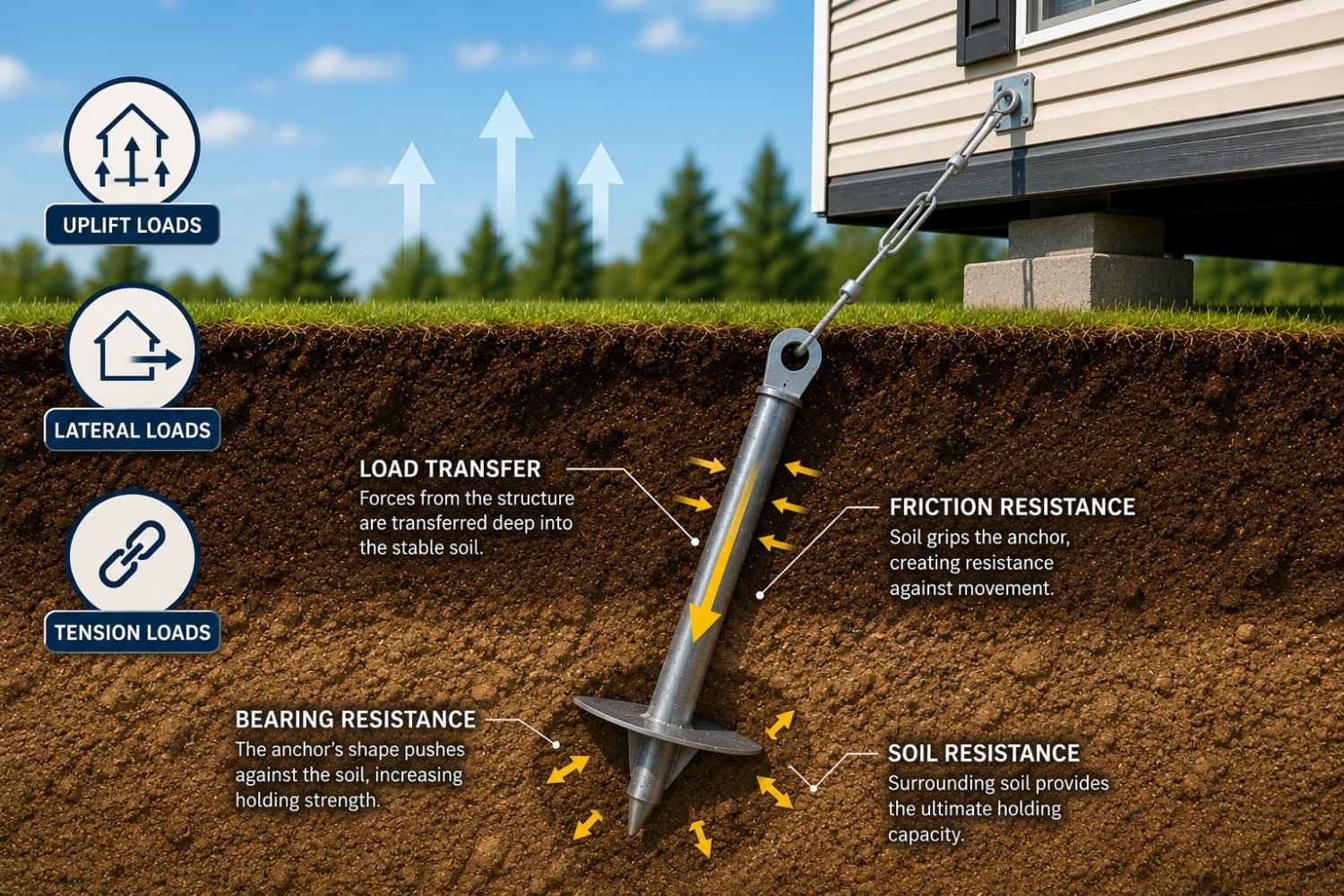
Understanding the Anchoring Principle: How Ground Anchors Hold Loads
Ground anchors are one of the most effective solutions for securing structures and transferring forces safely into the ground. They are used in applications such as retaining walls, mobile homes, utility installations, foundations, slopes, and structural stabilization projects.
But how do ground anchors actually hold loads?
The answer lies in the anchoring principle — the process of transferring external forces from a structure into the surrounding soil or rock through a secure underground connection.
At B & R Stamping, we manufacture Earth Anchors, Load Lock Anchors, Arrowhead Anchors, and Ground Anchoring Systems designed to provide reliable holding strength in various Canadian soil conditions.
What Is the Anchoring Principle?
The anchoring principle is based on one simple concept:
A ground anchor resists movement by transferring applied loads into the surrounding soil or rock.
When a force pulls on an anchored structure, the anchor does not rely only on its own strength. Instead, it uses the surrounding ground to create resistance.
The holding capacity depends on:
- Soil strength
- Anchor design
- Installation depth
- Soil density
- Ground conditions
- Load direction
The stronger and more stable the surrounding soil, the greater the anchor’s ability to resist movement.
How Do Ground Anchors Hold Loads?
Ground anchors hold loads through several important mechanisms:
1. Soil Resistance
When an anchor is installed underground, the surrounding soil pushes back against movement.
This creates resistance against:
- Pulling forces
- Wind uplift
- Structural movement
- Sliding forces
Dense soils typically provide higher holding capacity compared to loose soils.
2. Load Transfer
The anchor transfers forces from the structure into deeper soil layers.
For example:
A mobile home experiencing wind uplift creates upward force. The anchor transfers that force into the ground, where the surrounding soil provides resistance.
This prevents the structure from shifting or lifting.
3. Friction and Bearing Resistance
Ground anchors rely on two main resistance methods:
Friction Resistance
The soil grips the anchor surface and prevents movement.
Bearing Resistance
The anchor shape pushes against the soil, creating additional holding strength.
Many anchor designs, including Load Lock Anchors and Arrowhead Anchors, are engineered to maximize these resistance forces.
Factors That Affect Ground Anchor Holding Capacity
Soil Type
Different soils provide different levels of resistance.
Clay Soil
Dense clay can provide excellent holding strength because it creates strong resistance around the anchor.
Sandy Soil
Sand may require deeper installation because particles provide less bonding strength.
Gravel Soil
Compacted gravel can offer strong support but may create installation challenges.
Soft Soil
Soft soils may require larger anchors, deeper installation, or additional anchoring points.
Anchor Design
The shape and structure of an anchor directly affect performance.
Examples:
Helical Earth Anchors
Use spiral plates to create strong resistance in soil.
Arrowhead Anchors
Use an arrow-shaped design to penetrate and lock into the ground.
Load Lock Anchors
Designed for high holding capacity applications where secure load transfer is required.
Installation Depth
Deeper installation generally allows the anchor to engage stronger and more stable soil layers.
Proper installation depth helps:
- Increase holding strength
- Improve stability
- Reduce movement
- Extend service life
Understanding Anchor Load Types
Ground anchors commonly resist different forces:
Uplift Loads
These forces try to pull a structure upward.
Examples:
- Wind forces on mobile homes
- Pole movement
- Temporary structures
Lateral Loads
These forces push structures sideways.
Examples:
- Retaining walls
- Slope stabilization systems
Tension Loads
These are pulling forces applied directly to the anchor.
Proper anchor design ensures these loads are safely transferred into the ground.
Applications of Ground Anchoring Systems
Ground anchors are used in many industries, including:
Mobile Home Anchoring
Provides protection against wind uplift and movement.
Retaining Wall Stabilization
Helps secure walls and prevent soil movement.
Utility Installations
Supports poles, equipment, and infrastructure components.
Construction Projects
Provides temporary and permanent stabilization solutions.
Ground Stabilization
Helps improve safety in slopes, embankments, and unstable areas.
How Soil Testing Improves Anchor Performance
Before selecting a ground anchor system, soil evaluation helps determine:
- Soil density
- Ground resistance
- Moisture conditions
- Installation requirements
- Expected holding capacity
A torque probe or similar testing method can help measure soil resistance and identify the right anchoring solution.
Why Proper Anchor Selection Matters
Choosing the wrong anchor type can reduce performance and create safety risks.
The correct selection depends on:
- Project requirements
- Soil conditions
- Load requirements
- Environmental factors
At B & R Stamping, our Ground Anchoring Systems are designed to provide reliable performance for different applications and soil conditions across Canada.
Conclusion
The anchoring principle behind ground anchors is based on transferring loads from a structure into the surrounding soil or rock. Through soil resistance, friction, bearing forces, and proper installation, anchors create a stable connection that helps prevent movement.
Whether securing a mobile home, stabilizing a retaining wall, or supporting infrastructure, understanding how ground anchors hold loads is essential for choosing the right anchoring solution.
Recent Posts
- Custom Metal Fabrication in Oakville: Industry Applications
- How to Choose a Reliable Welding Company in Canada
- Best Practices for Anchor Placement and Installation
- Arrowhead Earth Anchors: Features, Benefits, and Applications
- Why Contractors Choose Load Lock Anchoring Systems
- How to Choose the Best Earth Anchor System for Construction Projects in Canada
- Understanding the Anchoring Principle: How Ground Anchors Hold Loads
- What Are Arrowhead Anchors and How Are They Used?
- What Are Leveling Jacks and Why Are They Important?
Frequently Asked Questions?
Ground anchors hold loads by transferring forces from a structure into the surrounding soil or rock, where resistance prevents movement.
Holding capacity depends on soil type, anchor design, installation depth, and ground conditions.
Deeper installation can improve holding capacity because anchors can engage stronger soil layers.
Ground anchors can be used in many soil conditions, but anchor type and installation methods must match the soil characteristics.
Earth anchors and ground anchors both secure structures to the ground, but specific designs and applications may vary depending on load requirements.
Soil testing helps determine the correct anchor type, installation depth, and expected performance before installation.