
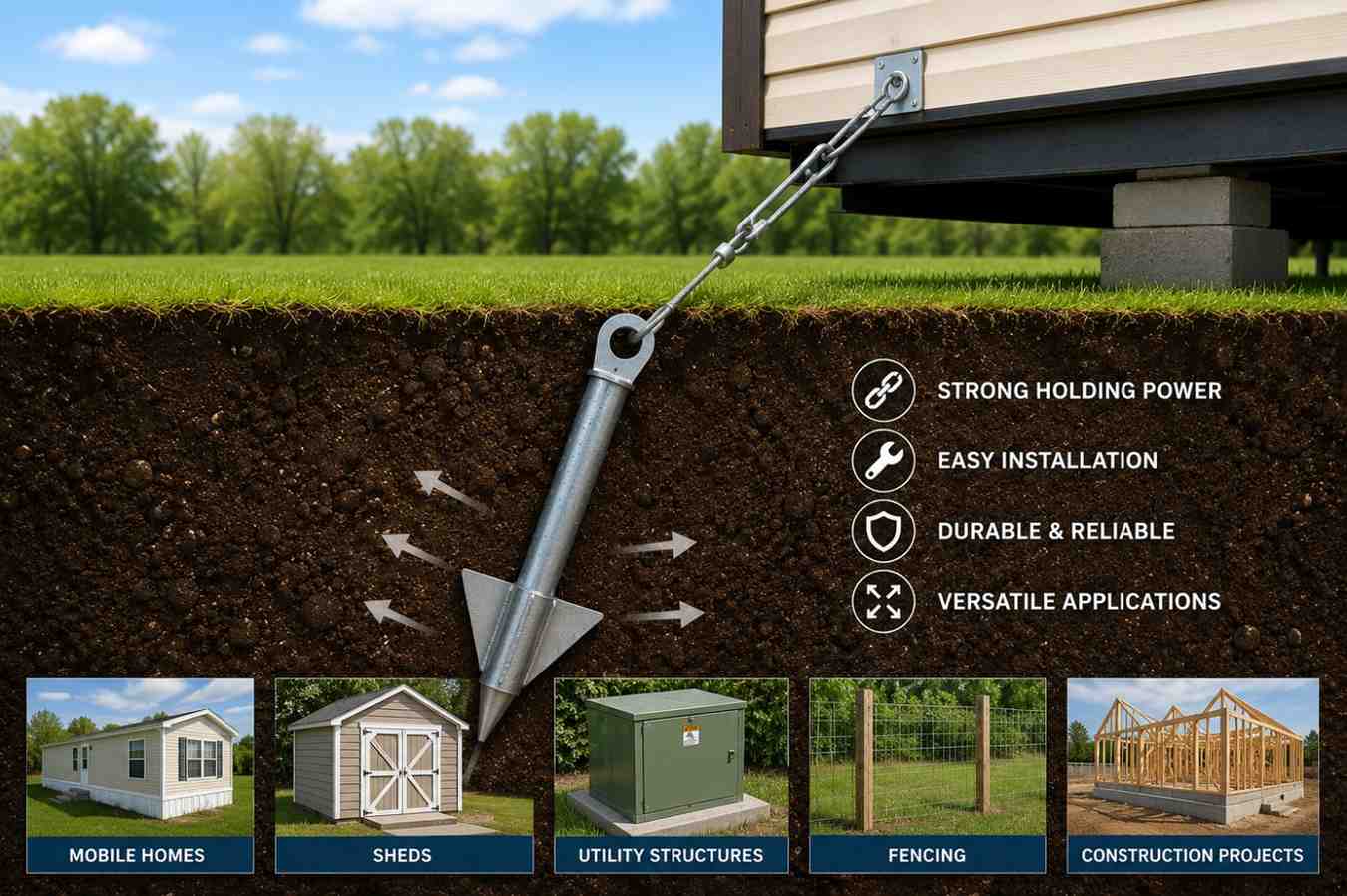
What Are Arrowhead Anchors and How Are They Used?
Arrowhead Anchors are specialized ground anchoring solutions designed to provide strong and reliable holding power in soil conditions where stability and secure installation are required. Their unique arrow-shaped design allows them to penetrate the ground effectively and create resistance against pulling forces, uplift, and movement.
Arrowhead Anchors are commonly used for mobile homes, sheds, utility structures, fencing, tie-down systems, and general ground anchoring applications where a dependable connection between a structure and the soil is needed.
At B & R Stamping, Arrowhead Anchors are manufactured for Canadian soil conditions and are designed to deliver long-lasting performance across residential, commercial, and construction applications.
How Do Arrowhead Anchors Work?
Arrowhead Anchors work by using their unique shape to lock into the surrounding soil after installation.
The basic process includes:
1. Installation Into the Ground
The Arrowhead Anchor is driven into the soil using appropriate installation equipment. Its pointed arrow-shaped design helps it penetrate different ground conditions efficiently.
2. Soil Engagement
Once installed, the anchor creates resistance by engaging the surrounding soil. The deeper the anchor is installed, the more soil resistance it can utilize.
3. Load Transfer
When the attached structure experiences movement or pulling forces, the anchor transfers the load into the surrounding soil.
4. Increased Holding Strength
The arrowhead design helps create a larger resistance area, improving stability and reducing the chance of pull-out.
Strong Holding Power
Arrowhead Anchors are designed to provide dependable resistance against movement, making them suitable for many anchoring applications.
Easy Installation
Their compact design allows efficient installation with minimal ground disturbance compared to traditional foundation methods.
Versatile Applications
They can be used for:
- Mobile homes
- Sheds
- Small structures
- Utility installations
- Equipment anchoring
- Ground stabilization projects
Long-Term Reliability
When properly installed according to soil conditions, Arrowhead Anchors provide durable performance and structural support.
Common Uses of Arrowhead Anchors
Mobile Home Anchoring
Arrowhead Anchors are commonly used in manufactured housing applications to help protect against wind uplift and movement.
They provide an effective connection between the home and the ground, improving overall stability.
Shed and Small Structure Anchoring
Sheds, garages, and outdoor structures can benefit from secure anchoring to prevent shifting caused by wind or ground movement.
Utility Structures
Arrowhead Anchors can support various utility-related installations where reliable ground connection is required.
Construction Applications
They can be used for temporary or permanent anchoring solutions depending on project requirements.
Arrowhead Anchors vs Traditional Anchoring Methods
Traditional anchoring methods may require large concrete foundations, extensive excavation, or additional materials.
Arrowhead Anchors offer advantages such as:
- Faster installation
- Reduced site disruption
- Strong soil engagement
- Flexible application options
- Lower installation complexity
Arrowhead Anchors in Different Soil Conditions
Soil conditions affect anchor performance.
Clay Soil
Dense clay can provide excellent holding capacity because the soil offers strong resistance around the anchor.
Sandy Soil
In loose sand, deeper installation may be required to achieve maximum holding strength.
Gravel Soil
Compacted gravel can provide good support, although large rocks may affect installation.
Soft Soil
Soft soils may require additional anchoring points or specialized installation methods to achieve the required stability.
A proper soil evaluation helps determine the best anchoring solution.
How to Choose the Right Arrowhead Anchor
The correct anchor selection depends on:
- Soil type
- Required holding capacity
- Structure size
- Environmental conditions
- Installation depth
- Project requirements
Professional guidance can help ensure the anchoring system matches the application.
Why Choose B & R Stamping Arrowhead Anchors?
For over 35 years, B & R Stamping has manufactured reliable anchoring products including:
- Arrowhead Anchors
- Load Lock Anchors
- Earth Anchors
- Ground Anchoring Systems
- Structural Support Products
Our products are designed for Canadian conditions and are used in applications including:
- Mobile homes
- Modular buildings
- Utility installations
- Construction projects
- Ground stabilization systems
Conclusion
Arrowhead Anchors provide an effective and reliable solution for securing structures to the ground. Their unique design helps transfer loads into surrounding soil, providing stability against movement and uplift.
Whether used for mobile homes, sheds, utilities, or general anchoring applications, choosing the correct Arrowhead Anchor System helps improve safety, durability, and long-term performance.
Recent Posts
- Arrowhead Earth Anchors: Features, Benefits, and Applications
- Why Contractors Choose Load Lock Anchoring Systems
- How to Choose the Best Earth Anchor System for Construction Projects in Canada
- Understanding the Anchoring Principle: How Ground Anchors Hold Loads
- What Are Arrowhead Anchors and How Are They Used?
- What Are Leveling Jacks and Why Are They Important?
- What Are Load Lock Anchors and How Do They Work?
- Earth Anchors vs Ground Anchors: Which Solution Is Right for Your Project?
- How Do Earth Anchors Work in Different Soil Conditions?
Frequently Asked Questions?
An Arrowhead Anchor is a ground anchoring system with an arrow-shaped design that penetrates soil and creates resistance to secure structures.
They are used for mobile homes, sheds, utility structures, fencing, and other applications requiring ground stability.
They hold by transferring loads into the surrounding soil and using soil resistance to prevent movement.
Yes. Arrowhead Anchors are commonly used for mobile home anchoring systems to help resist wind uplift and movement.
Yes, but performance depends on soil type, density, moisture, and installation depth.
Installation requirements depend on the project size and soil conditions. Proper installation ensures maximum holding performance.