
THE ANCHORING PRINCIPLE
The Load Locks Complete anchor works using a unique anchoring method known as “planning”, rather than relying on a traditional cone of resistance like many conventional anchors. The Load Locks anchor is inserted into a drive rod, which pushes the anchor end first into the ground to the required depth. Once the anchor reaches the desired depth, an upward pull causes the anchor to plane into a locked position beneath the soil surface.
As upward tension continues, the anchor begins to plane sideways through the earth. During this process, the anchor pulls against the undisturbed surrounding soil, which significantly increases its anchoring capacity and holding strength. This anchoring principle allows the Load Locks Complete system to achieve maximum stability and reliable anchoring performance in a variety of soil conditions.
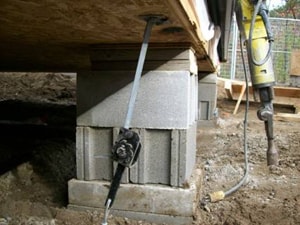
Soil Test Methods
Understanding soil conditions is an important part of determining the correct installation depth for earth anchors. The resistance encountered while driving the anchor into the ground provides a useful indication of soil type and density. Softer soils usually create less resistance during installation, which means the anchor may need to be placed deeper to achieve maximum strength and stability.
Proper soil evaluation helps ensure that the anchor system provides reliable performance and strong structural support.
Torque Probe Readings
For more detailed soil classification, a Soil Test Probe can be used to measure sub-soil conditions without the need for core samples. This method provides a simple and efficient way to determine underground soil strength before installing anchors.
A ratchet handle torque wrench slides up and down the probe shaft and is used to install and retract the probe. The torque wrench produces readings in inch-pounds, which measure the consistency and resistance of the sub-soil. These torque values can then be used to determine soil classifications, and multiple readings can be taken at different depths to better understand soil conditions.
Frame Tie Downs
The number of frame tie-downs required to secure a mobile home depends on several factors, including the length and shape of the unit, wind speed and direction in the area, and the type of connection between the unit and its steel supporting frame. Proper anchoring ensures that the structure remains stable and protected against environmental forces.
Leveling Jacks for Structural Support
Concrete blocks are often used for structural support, but they can break, chip, or weaken over time, which may affect stability. At B & R Stamping, our Leveling Jacks are designed to provide stronger and more dependable support to keep structures stable and properly balanced. These jacks help distribute the load evenly and maintain structural stability over time.
Frequently Asked Questions (FAQ)
The Load Locks Complete anchor works using a planning principle. Once driven into the ground, an upward pull causes the anchor to rotate and plane sideways beneath the soil surface. This allows the anchor to pull against undisturbed soil, increasing its holding power and anchoring capacity.
Soil testing helps determine the strength and consistency of the soil, which affects how deep the anchor should be installed. Proper soil evaluation ensures that the anchor system provides maximum holding power and structural stability.
A torque probe is used to measure underground soil resistance. The readings from the torque wrench help classify soil conditions and determine the most suitable anchor installation depth.
The number of tie-downs depends on several factors including the length of the mobile home, wind conditions in the area, the design of the unit, and the connection between the structure and its supporting frame.
Leveling jacks provide stronger and more reliable structural support than concrete blocks. Concrete blocks can crack or break over time, while leveling jacks help keep the structure stable and properly balanced.